Make sure you read the three follow-up blog posts!
This isn't just another special election; it's a stark preview of the shifting dynamics within Georgia's most reliably conservative district. For the Republican Party, the fragmentation of its vote share and the significant pool of undecided voters represent a critical test of leadership and brand appeal. Can a candidate emerge to unify the diverse conservative factions and capture the crucial suburban vote? Or will the internal divisions allow a Democratic candidate to secure an unlikely runoff victory in a district considered a GOP stronghold? The answers will not only determine the future representation of GA-14 but will also send a powerful signal about the Republican Party's direction in Georgia for the 2026 cycle and beyond.
Who is leading the GA-14 Special Election?
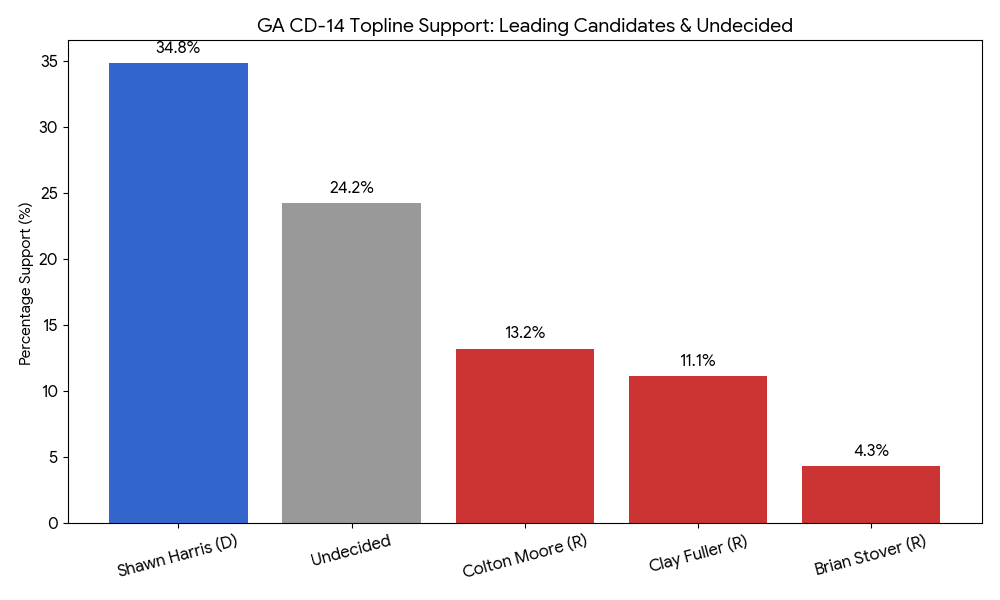
According to our latest polling data, Shawn Harris (D) holds a significant plurality with 34.8% of the vote. Harris has successfully consolidated the Democratic base, capturing nearly 94% of the district's Democratic support.
On the Republican side, the race for the final runoff spot is a statistical dead heat.
Colton Moore (R) currently holds
13.2%, followed closely by
Clay Fuller (R) at
11.1%. With over 15 Republican candidates on the ballot, the GOP vote is highly fragmented, making the second-place finish the most volatile aspect of the race.
The "Undecided" Factor: A 24% Kingmaker
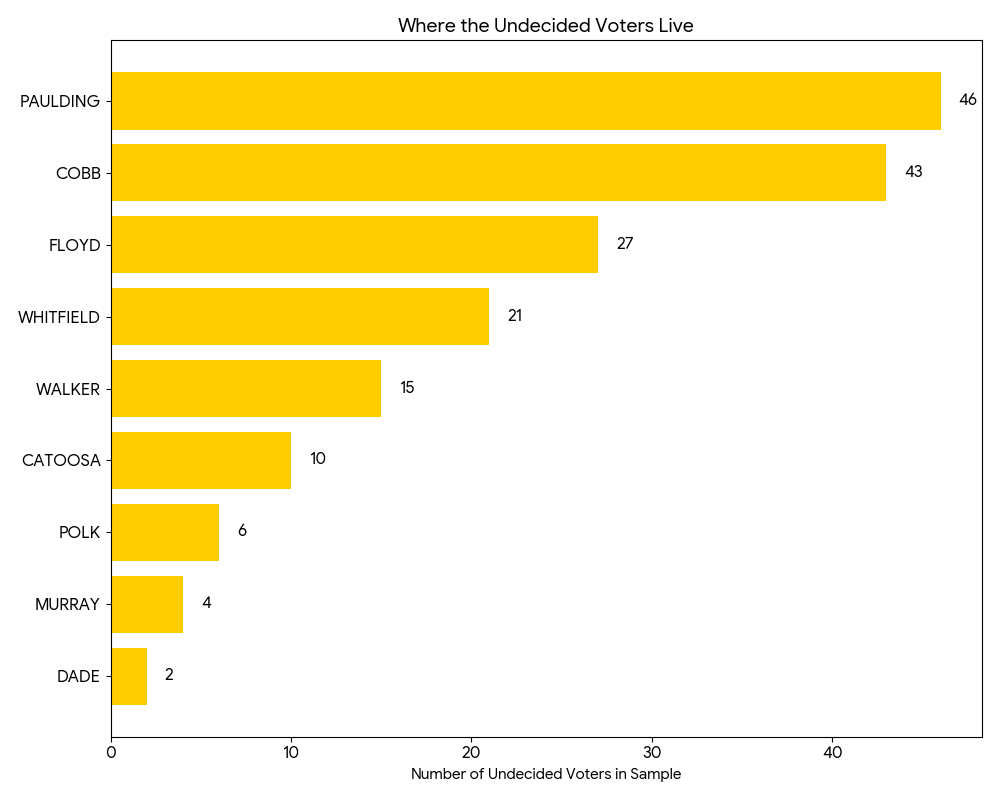
Perhaps the most significant finding is that 24.2% of voters remain undecided. This group represents the single largest "bloc" of voters after Shawn Harris. Notably, these undecided voters are concentrated in the suburban corridors of Paulding and Cobb Counties.
What issues are driving Georgia's 14th District voters? Voters aren't just looking at names; they are looking at structural trust. The poll found that 71.7% of respondents rank Election Integrity and secure voter identification as "Very Important"—the highest-ranked issue across all demographic groups.
Key Logistics: March 10 vs. April 7
Because this is a special election, all 22 qualified candidates will appear on a single "Jungle Primary" ballot on March 10, 2026. There is no traditional party primary.
- The Runoff Rule: If no candidate secures more than 50% of the vote on March 10, the top two finishers will advance to a Special Runoff Election on April 7, 2026.
Summary of Key Poll Findings:
- Democratic Consolidation: Shawn Harris (34.8%)
- GOP Fragmentation: Colton Moore (13.2%) vs. Clay Fuller (11.1%)
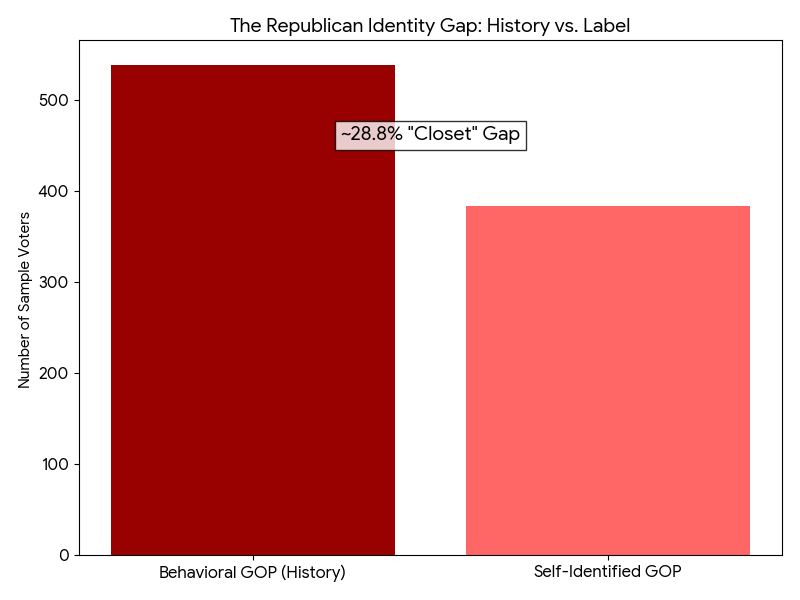
- The Brand Gap: 19% of voters have a Republican voting history but refuse to identify as "Republican" in the poll.
Defining the "Brand Damage" Factor
As you review the Toplines and Crosstabs, the most critical metric to watch is Brand Damage. In political terms, this measures "Party-Averse" behavior—voters who behave like Republicans at the ballot box but refuse to associate with the "Republican" label in public.
The Example: Look at the supporters of Shawn Harris (D). While he is a Democrat, 16% of his current supporters are "Behavioral Republicans"—voters with a consistent history of taking GOP primary ballots.
This is the definition of high Brand Damage: voters so exhausted by the current party image that they are parking a "protest vote" with a Democrat. If a Republican candidate can "repair" this brand by offering a traditional, safe alternative, these votes return to the GOP column instantly.
Survey Dates: The data was gathered over a three-day period from January 27 to January 29, 2026.
Sample Size: We surveyed 835 voters across all 10 counties in Georgia’s 14th Congressional District.
Margin of Error (MOE): The margin of error for this survey is ±3.4% at a 95% confidence level.
Participant Selection: Respondents were selected from a universe of "Strong GOP" and "Strong Democrat" voters—those with a proven behavioral history of high-turnout and consistent partisan participation.